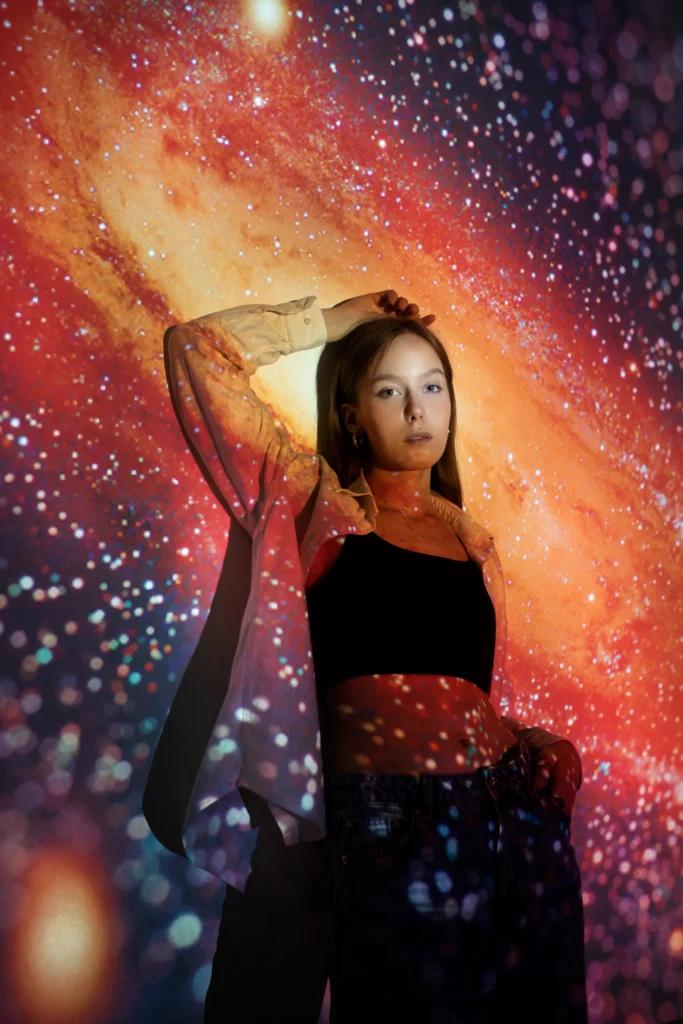
Whilom, before the cameras, the characters, the songs and the ever changing demands of the entertainment industry, there was a young girl who simply wanted to belong. Victoria Viera began acting at an early age, initially drawn towards the profession partly because a select group of her cousins were appearing in commercials and she wanted to experience that world for herself, along with the approval of her grandmother. What began almost innocently would become a career spanning more than a decade, taking her through Mexican telenovelas, television, film, theatre, comedy, dramatic roles and music. Today, she looks back on that journey with the perspective of an artist who has learned that a career is never only about being seen. It is about listening, adapting, remaining curious and understanding the extraordinary vulnerability that comes with being an artist.
Starting young meant that acting became part of Victoria’s development rather than simply a profession she entered as an adult. She grew up learning how to understand stories through the eyes of other people, and that experience shaped the way she approaches both her craft and the world around her. Acting taught her to listen and to remain curious about people, while the different mediums she encountered each offered their own lessons. Television taught her to adapt quickly, film taught her to trust smaller moments and theatre taught her the importance of complete presence, because there is no opportunity to stop and repeat a scene for a live audience. Singing eventually gave her another form of storytelling, but with one crucial difference. On stage or in front of a camera she can disappear into another person, whereas music brings her back to herself.
That distinction has become increasingly important as Victoria has grown into her artistic identity. When she first began acting, her attention was largely focused on learning lines and getting scenes right. With experience came a deeper curiosity about the person behind the dialogue. Today, she wants to understand what a character truly wants, what she is afraid to say, how she behaves when nobody is watching and whether there might be another intention beneath the words being spoken. For Victoria, a character can say something without meaning it, carry a hidden agenda or reveal more through behaviour than dialogue. Those questions have transformed her preparation from simply memorising words into an exploration of psychology, motivation and human behaviour.
More than ten years in the industry have also given her greater confidence in making creative choices. She has learned that preparation is essential, but preparation does not mean knowing exactly how every moment should unfold. Acting is collaborative, and the discovery that takes place between performers can change a scene in unexpected ways. At the same time, she understands the hierarchy of a production and the importance of a director’s vision. Having worked on six telenovelas, she has experienced the challenge of balancing her own instincts with the director’s interpretation and the approaches of fellow actors. Finding that balance requires flexibility, humility and enough confidence to contribute without losing sight of the larger story.

The differences between television, film and theatre have therefore become an important part of her artistic education. Theatre demands sustained energy and concentration because an actor must carry a character’s emotional journey from beginning to end, often night after night, while remaining connected to a live audience. Film can be far more intimate, with a camera capable of capturing a thought before a word is spoken. Television brings its own demands, often requiring actors to move quickly through scenes that may be filmed out of sequence. Victoria has learned to adjust the scale and rhythm of her performance without compromising the emotional truth of the character. Each medium has its own language, and learning those languages has made her more adaptable without making her less herself.
Her choice of projects reflects that curiosity. Victoria is drawn towards characters who make her want to ask questions, and the diversity of her work has allowed her to explore very different emotional landscapes. Her roles in Papás por Conveniencia, Papás por Siempre, Familia de Diez, Ellas Soy Yo, Distroller and Dad Wanted have placed her in dramatically different creative environments. She values that variety because it prevents the work from becoming predictable. For Victoria, the appeal of acting lies in the possibility of stepping onto a set and discovering what might happen when a script, a director and a group of actors come together.
There is an unmistakable enthusiasm in the way she talks about acting. She loves being on set, imagining her dialogue and seeing what her fellow performers bring to a scene. She describes herself as someone who would happily accept almost any role, with a few personal boundaries that include nudity and gore. That openness reveals something important about her relationship with the profession. Acting is not simply a vehicle for recognition. She genuinely enjoys the process of creation and the unpredictability that comes with it.
For Victoria, the emotional truth of a character begins with understanding rather than judgement. Even when she would personally make a completely different choice, she tries to discover why that decision makes sense to the woman she is portraying. She searches for universal emotions such as the desire to belong, the fear of losing someone or the instinct to protect oneself, using her own experiences as a bridge into the character. Yet personal experience is only one part of the process. The script, director and scene partners all contribute to the final performance. She believes that an actor must love a character before an audience can love her, because empathy is where the magic begins.

Some of her roles have demanded particularly different forms of emotional access. Circe in Papás por Conveniencia and Papás por Siempre allowed audiences to see an outspoken and preppy young woman whose initial sharpness gradually revealed a more vulnerable and loyal personality. Victoria understood the importance of allowing the audience to discover that complexity rather than presenting it immediately. The character’s journey demonstrated how perception can change when viewers are given time to understand what exists beneath someone’s exterior.
Heidi in Ellas Soy Yo, the Gloria Trevi biographical series, took her into much darker territory. The character was caught within a disturbing dynamic involving manipulation and an older man possessing significant psychological power over young women. The material was challenging, but it provided Victoria with an opportunity to explore vulnerability and the darker dimensions of human behaviour. It also reinforced one of the reasons she continues to value acting. Every character can reveal something about people that she might not otherwise have the opportunity to understand.
Comedy presented another challenge altogether. Her work as Victoria in Una Familia de Diezrequired a different rhythm and a different relationship with timing. Comedy depends heavily on pace, reactions and precision, and the experience pushed her beyond some of the approaches she had previously developed. It also introduced an aspect of public visibility she had understood intellectually but experienced differently once it became personal: social media criticism. Receiving hate online was painful, even though she knew intellectually that public figures can attract negative reactions. What surprised her was the response from her own audience, who defended her in lengthy conversations across social media. Watching those debates unfold showed her that the relationship between an actor and an audience can become far more emotionally involved than statistics or follower counts suggest.
That relationship is something Victoria values deeply. She understands that audiences may love one character, dislike another, laugh with one and feel represented by another. Those emotional reactions are evidence that something has connected. For an actor, that connection can be one of the most meaningful rewards of the profession. It means that a fictional person has moved beyond the script and entered someone’s emotional world.
While acting allows Victoria to inhabit other people, music provides her with a place where she does not have to disappear at all. Singing has become a deeply personal form of release, particularly after demanding days on set that can sometimes last twelve hours. When she returns home exhausted, she often goes directly to the piano, begins playing and singing, and allows herself to drift away from the intensity of the working day. Music offers a different kind of freedom because there is no character to hide behind. There is simply her voice.
That distinction is central to her ambitions as a musician. Breaking into the music industry has proved very different from building a career as an actress, and she acknowledges that the transition is challenging. Yet the difficulty has not reduced the ambition. If anything, it has made the possibility more exciting. She wants to discover what might happen when the audience hears Victoria rather than one of the many characters she has portrayed.

Her ambitions have expanded considerably since those early days when she simply wanted to be part of a world occupied by her cousins. Over the years, larger roles and more complicated characters brought increasing responsibility, but they also revealed the collaborative nature of acting. A young performer may begin with a handful of lines, perhaps spending an entire scene sitting at a table and eating, but the demands grow as the career develops. More dialogue brings greater responsibility, while more complex characters require greater emotional preparation. Eventually, an actor learns that no performance exists in isolation. It emerges from the intersection of the actor’s choices, the director’s vision, the script and the contributions of everyone else involved.
Victoria’s creative ambitions now extend beyond acting and singing. She has also developed a passion for writing short stories, having taken two writing courses and discovering that ideas sometimes arrive unexpectedly in the middle of the night. She describes waking with a story in her mind and immediately beginning to write, allowing the words to flow without stopping to edit. Many of these stories have a darker quality, combining thriller elements with a touch of terror, and she hopes that one day one of those ideas could become a horror film. The possibility represents another natural extension of her storytelling instincts. Whether she is acting, singing or writing, she remains fascinated by the human imagination and the stories it creates.
There is also a clear international ambition within her future plans. Victoria wants to appear in international films and series and hopes to see her work reach audiences beyond the markets in which she has already established herself. She also dreams of seeing her image on international billboards. Yet the desire for recognition is not simply about fame. She sees visibility as a tool. A larger platform can create greater opportunities to communicate, connect with audiences and bring attention to causes that matter to her.
Her understanding of that responsibility extends beyond her professional work. Victoria has supported animal shelters, homes for single mothers and visited juvenile detention centres, experiences that have encouraged her to look beyond the boundaries of her own career. Those encounters have remained with her because they offered a different perspective on life and reminded her that visibility can be used for more than promotion. The larger the audience, the greater the possibility of directing attention towards something meaningful.
The digital world has complicated that relationship with visibility. Social media moves at a speed that can make the entertainment industry feel even more unpredictable. New formats emerge constantly, trends appear and disappear, and audiences can shift their attention almost overnight. Victoria chooses not to chase every trend simply because it is popular. She manages her own social media, from posting and editing to responding to comments, which means she has to be selective about where she invests her time. With only twenty four hours in a day, she prefers to remain curious about new developments while participating when something genuinely feels relevant to her.
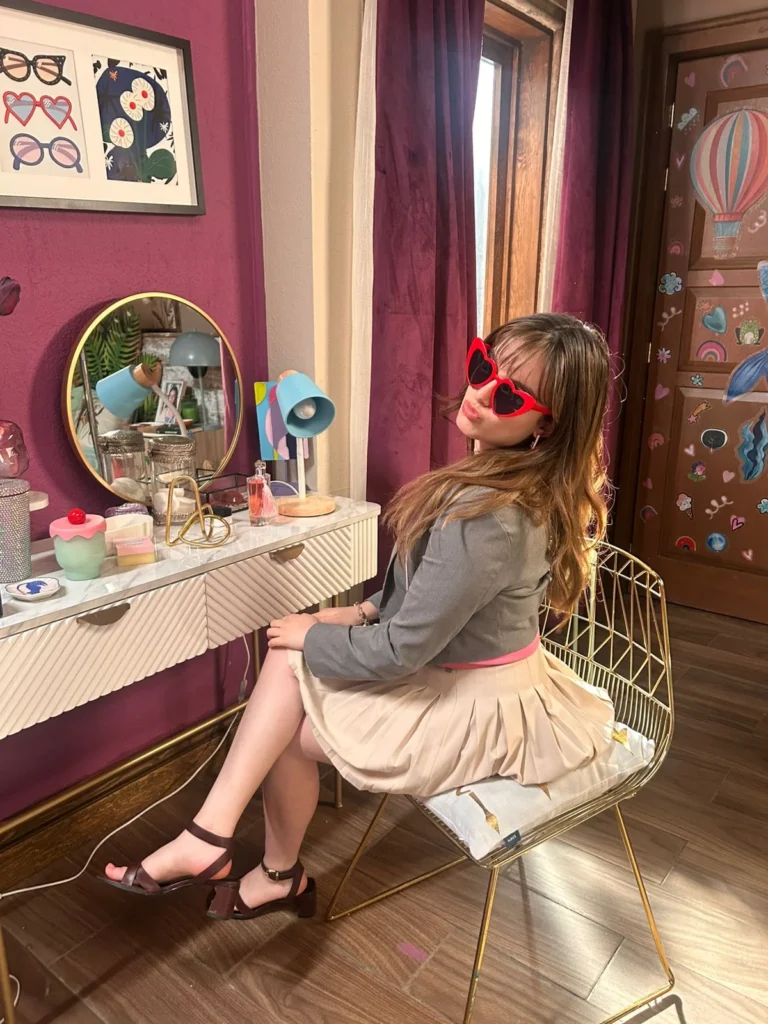
She is particularly interested in the development of vertical series and the possibilities created by audiences increasingly watching stories on their phones. She has not yet worked on one or auditioned for one, but she recognises that the format could require actors to reconsider how stories are performed and consumed. Digital platforms have already transformed the relationship between artists and audiences, and Victoria sees that direct connection as one of the most valuable developments of the modern entertainment landscape.
Yet beneath the changing platforms and new formats, her philosophy remains remarkably consistent. She does not want technology to determine who she becomes as an artist. She wants it to provide new ways to communicate while preserving the qualities that matter most to her: curiosity, authenticity and connection.
That philosophy also explains her understanding of the entertainment industry itself. Victoria has witnessed how quickly public attention can change. One day an artist can be the talk of the town and the next day find themselves outside whatever profile is currently considered fashionable. She considers herself fortunate to have worked consistently in primetime since appearing in her first Mexican telenovela a decade ago, and she does not take that consistency for granted. Instead, she sees it as a reason to remain grateful. In an industry where visibility can be temporary, every opportunity becomes something worth appreciating.
Perhaps that awareness has made her ambitions more expansive rather than less. She understands that longevity cannot be taken for granted, so she continues to learn, explore and create. The goal is not simply to remain visible but to remain relevant to herself. That distinction matters because an artist can continue working while becoming creatively stagnant. Victoria wants the opposite. She wants each new chapter to introduce something she has not experienced before.
Ultimately, what she hopes audiences remember is surprisingly simple. She wants to be remembered as a good actress, a good singer and, above all, a good human being. The order feels significant. Her ambitions are large, and she openly dreams of international recognition, but the legacy she values most is not built from credits alone. It is built from how she treats people, what she creates and what she chooses to do with the opportunities she receives.
Victoria Viera’s story is therefore not simply about a child actor who grew into an established performer. It is about an artist who has continued to discover new ways of telling stories while learning how vulnerable the profession can be. Acting taught her to look through another person’s eyes. Singing taught her to speak through her own. Writing has given her another space in which imagination can take over. Each discipline reveals a different part of the same woman.
There is still much she wants to accomplish. International film and television remain ambitions, music continues to call her forward, and the stories that arrive in the middle of the night may one day become something much larger. She does not know which dream will lead her somewhere unexpected, and perhaps that uncertainty is part of the excitement. After more than a decade in an industry built on change, Victoria has learned not to demand that the future reveal itself too early.
What remains clear is that she intends to keep telling stories. Sometimes through someone else’s eyes. Sometimes through her own voice. And, wherever the next chapter takes her, with the hope that the work leaves behind something more lasting than applause.