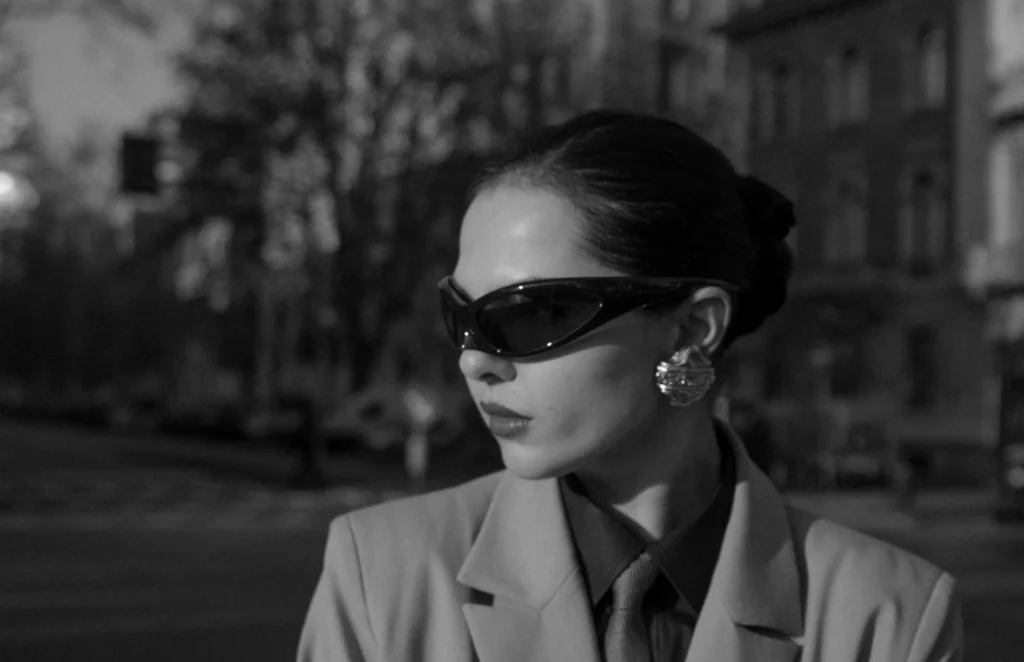
There is a rare clarity in the way Anouk Yve Bos sees the world, a quiet certainty that allows her to strip things back until only what truly matters remains. Her work, spanning fashion, interiors, ceramics, and lifestyle, is not built on rigid philosophy but on instinct sharpened over decades. She speaks of an almost unexplainable feeling, a moment when something is simply right. A room, an outfit, an object that does not demand attention yet holds it completely. This intuitive precision defines her aesthetic, one that embraces minimalism not as absence, but as a careful, warm refinement where every detail earns its place.
Her visual identity did not emerge overnight, nor was it constructed with intention toward an audience. It was shaped by movement, by living across cities that each left their imprint. Stockholm instilled a sense of quiet intentionality, London introduced spontaneity and edge, while California softened everything with an ease that felt natural and unforced. Years of adapting to different homes and environments led her away from imitation and toward distillation. What she did not want became clearer before what she did. She rejected trend-driven choices, excess, and anything that felt inauthentic. From that clarity, her signature approach formed organically, grounded in strong personal conviction rather than external influence.
This same clarity guided the creation of Nota, her tea brand, born from a deeply personal shift. Entering her forties brought a heightened awareness of how her body responded to everyday rituals. Coffee no longer felt good, alcohol disrupted her rest, and the question became what could replace those familiar comforts. Tea offered an answer, but not in the traditional sense. She approached it as she does everything, with curiosity and precision, working closely with experts to create blends that correspond to modern moments of living. Each tea became tied to a feeling or need, whether it is calm focus, celebration, or restoration. What began as a personal solution has grown into something far more meaningful, a daily ritual for many who find in it a sense of grounding and belonging.

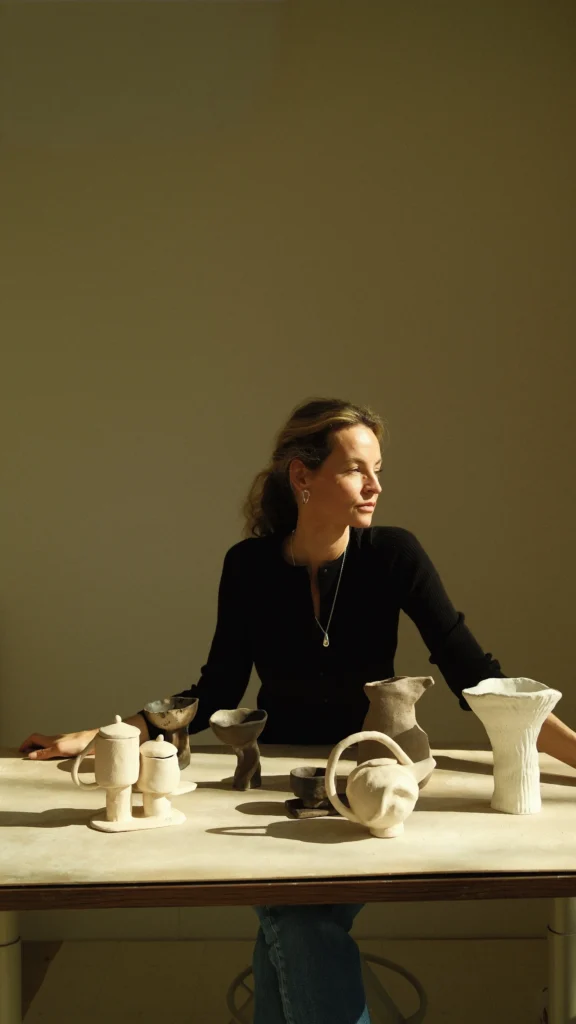
Despite her large audience, she maintains a clear boundary between living and sharing. Her spaces are not styled for content, they are lived in. The ceramics on her shelves are her own, shaped by hand, imperfect and deeply personal. Her wardrobe is built on longevity rather than constant renewal. Beauty, in her view, is not something to be created for display but protected through restraint. The decision of what to leave out is just as important as what remains. Empty space is not a gap to be filled, but an intentional choice that allows everything else to breathe.
Her relationship with minimalism was not immediate. Like many, she experienced excess first, a phase of accumulation that ultimately revealed its own limitations. The constant management of more, more clothing, more objects, more visual noise, became exhausting. Moving toward restraint brought a sense of ease, opening space mentally and creatively. It refined her eye further, allowing her to focus on quality, proportion, and longevity. Minimalism, for her, is not about owning less for the sake of it, but about owning exactly what resonates, nothing more, nothing tolerated.
Working with ceramics offers a counterbalance to the precision that defines much of her work. Clay introduces an element of unpredictability that she embraces fully. It removes control, allowing imperfection to take shape in a way that feels restorative. Each piece carries a sense of tactility that cannot be replicated digitally, a weight and texture that reconnects her to the physical world. This process influences everything else she does, reinforcing the idea that perfection is not the goal, but authenticity is.

Her collaborations follow the same uncompromising logic. The decision is simple, almost instinctive. Would she own it regardless of the partnership. If the answer is not immediate, it is no. The brands she aligns with share a commitment to longevity and thoughtful design, creating pieces that integrate seamlessly into a life lived with intention. It is never about volume or visibility, but about fit, silhouette, and whether something truly belongs.
In an industry saturated with imagery, she protects her originality through limitation. Time spent on digital platforms is intentionally restricted, allowing her to avoid the constant influx of visual influence that can dilute personal perspective. Inspiration is found elsewhere, in films, in books discovered unexpectedly, in slow travel that allows for repetition and familiarity. She values the act of observing without capturing, learning to experience beauty without the need to document it. For her, originality is not born from endless input, but from careful selection followed by space to process.

Her home stands as a physical reflection of everything she believes in. Built over several years in the north of the Netherlands, it is a midcentury villa immersed in nature, where light and landscape shape daily life. The environment is not separate from identity, it actively informs it. Every object within the space carries meaning, whether it is furniture chosen with precision or artwork that holds personal history. Nothing exists without purpose, and nothing is there by chance.
Across all disciplines she engages with, there is no sense of separation. Fashion, interiors, and architecture are different expressions of the same underlying principle. It is always about proportion, about how something exists within space, about the subtle balance that makes something feel complete. A garment and a room solve the same problem in different forms. The boundaries between these worlds dissolve when approached with the same question in mind, what does it mean for something to be exactly right.